
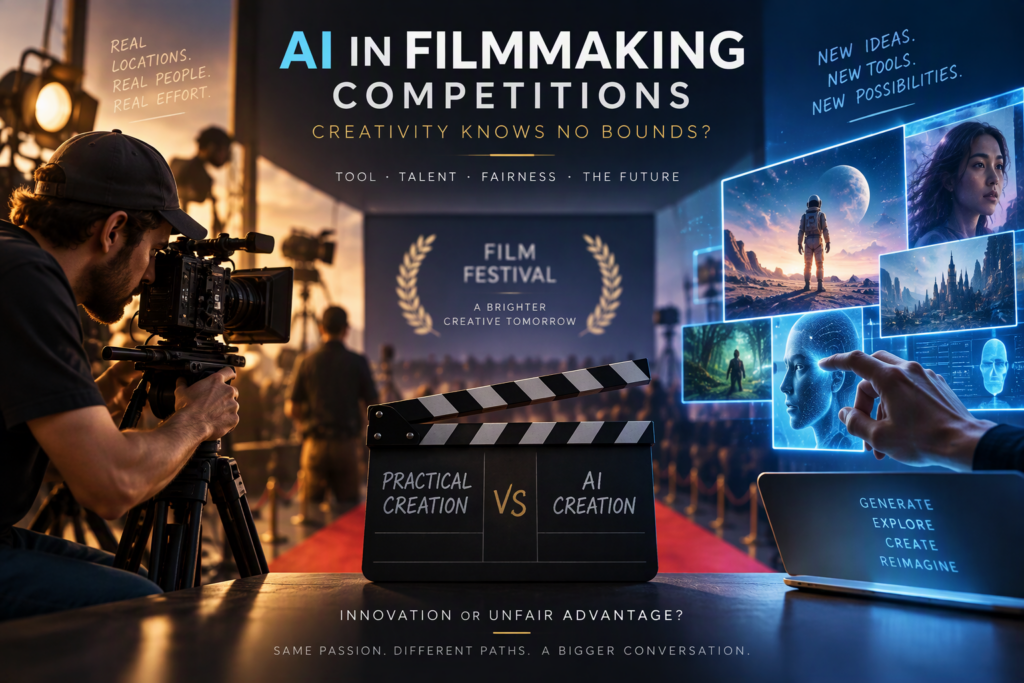
AI in Filmmaking Competitions: Innovation or Unfair Advantage?
Artificial intelligence has become one of the most disruptive forces in modern filmmaking. Platforms such as Google Flow, Runway, Pika, Luma AI, and OpenAI Sora enable creators to generate scenes, visual effects, characters, and entire short films from text prompts. As AI-generated films begin appearing in competitions and festivals worldwide, a contentious question has emerged:
Is using AI in filmmaking competitions simply another creative tool, or is it a form of cheating?
The answer depends largely on how we define creativity, craftsmanship, and competition.
The Case for AI: A New Creative Tool
Supporters argue that AI is no different from any technological advancement that has transformed filmmaking in the past.
When digital cameras replaced film, some filmmakers complained that the craft was being diluted. Similar concerns arose when non-linear editing systems replaced physical film cutting, and when CGI reduced the need for practical effects. Yet today, these tools are accepted as legitimate parts of filmmaking.
From this perspective, AI is simply the next step.
Creativity Still Comes from Humans
Even the most advanced AI tools require human direction. Creators must:
- Develop concepts and narratives
- Write prompts
- Refine outputs
- Edit generated content
- Make artistic decisions
- Build coherent stories
A poorly conceived prompt rarely produces a compelling film. Supporters argue that AI does not eliminate creativity; it changes where creativity is applied.
Lowering the Barrier to Entry
Traditional filmmaking can be expensive.
Producing a competition-quality short film may require:
- Professional cameras
- Lighting equipment
- Audio gear
- Actors
- Locations
- Editing software
AI dramatically reduces these costs.
A student with a laptop can now create visuals that previously required substantial funding. Advocates see this as a democratization of filmmaking rather than an unfair advantage.
AI Could Create New Art Forms
Filmmaking competitions have historically rewarded innovation.
Many AI creators argue that prompting, scene design, model training, image generation, and AI-assisted editing represent emerging artistic disciplines deserving recognition in their own right.
Just as animation became a separate category from live-action filmmaking, some suggest that AI filmmaking may become its own respected genre.
The Case Against AI: Why Some Call It Cheating
Critics argue that filmmaking competitions are often intended to measure filmmaking skills, not prompt-writing skills.
This distinction lies at the heart of the debate.
Traditional Craftsmanship Is Reduced
A conventional filmmaker might spend weeks:
- Scouting locations
- Directing performers
- Setting up lighting
- Operating cameras
- Recording sound
- Managing production teams
An AI creator might generate similar-looking footage in hours.
Opponents argue that competitions should reward the effort and expertise involved in practical production.
If one competitor spends months creating scenes physically while another generates them with AI, are they truly competing on equal terms?
AI Relies on Existing Training Data
A more controversial criticism concerns the datasets used to train generative AI models.
Some filmmakers argue that AI systems have learned from vast collections of films, artwork, photography, and media created by human artists.
Critics claim that AI-generated work may indirectly benefit from creative efforts that belong to others. While AI developers dispute characterizations that equate training with copying, the ethical debate remains unresolved in many creative industries.
Authenticity Matters
Many audiences value the knowledge that something was genuinely filmed.
The achievement of:
- Building a physical set
- Capturing a difficult shot
- Directing a skilled performance
- Creating practical effects can be an important part of how artistic work is judged.
When AI can simulate these achievements, critics argue that audiences may be impressed by results that did not require equivalent practical skill.
Is AI Creation the Same as Practical Filmmaking?
The simple answer is no, but that does not necessarily make it less creative.
Practical filmmaking and AI filmmaking involve different skill sets.
|
Practical Filmmaking |
AI Filmmaking |
|
Camera operation |
Prompt engineering |
|
Directing actors |
AI scene generation |
|
Lighting design |
Visual reference design |
|
Location management |
Model selection |
|
Physical production |
Iterative generation |
|
On-set problem solving |
Output refinement |
Both require creativity.
Both require technical competence.
However, they do not test the same abilities.
A useful comparison might be photography versus digital illustration. Both can produce stunning imagery, but few would argue they are identical disciplines.
How Competitions May Need to Adapt
Many competitions are already exploring new categories rather than banning AI outright.
Possible approaches include:
Option 1: Separate AI Categories
Competitions could create dedicated awards for:
- AI-generated films
- Hybrid productions
- AI-assisted storytelling
This mirrors how animation, documentary, and live-action films are often judged separately.
Option 2: Full Disclosure
Filmmakers could be required to disclose:
- Which AI tools were used
- How much content was generated
- Which aspects were human-created
Judges could then evaluate entries with greater transparency.
Option 3: Limit AI Usage
Some competitions may choose to allow AI only for:
- Visual effects
- Background generation
- Audio enhancement
- Colour grading while requiring principal footage to be captured traditionally.
Option 4: Open Competition
Others may embrace a completely open format in which results matter more than methods.
In this model, the best story wins regardless of how it was produced.
So, Is It Cheating?
The answer depends entirely on the rules of the competition.
If AI use is prohibited and a participant secretly uses it, then yes, it is cheating.
If AI use is permitted, disclosed, and judged according to the competition’s rules, then it is simply another production tool.
The more difficult question is whether AI-created films should compete directly against traditionally produced films. Here, reasonable people can disagree.
Traditional filmmakers often feel that years spent mastering cameras, lighting, directing, and production are being devalued.
AI creators argue that every generation faces resistance to new technology and that creativity should be judged by the final work, not the process behind it.
Final Thoughts
The debate surrounding AI in filmmaking competitions is not really about technology. It is about what society chooses to value in creative work.
Do we reward the final result?
Do we reward the process?
Or should we reward both?
AI is unlikely to disappear from filmmaking. Tools such as Google Flow, which combines AI video, image, and audio generation capabilities into a unified creative platform, demonstrate how rapidly the field is evolving.
The most likely future is not one where AI replaces filmmakers, but one where filmmakers who understand AI gain new creative possibilities. The challenge for competitions will be finding fair ways to celebrate both technological innovation and traditional craftsmanship.
